ファイル:Exoplanet Mass-Radius Scatter Super-Earth.png
概要
| 解説 |
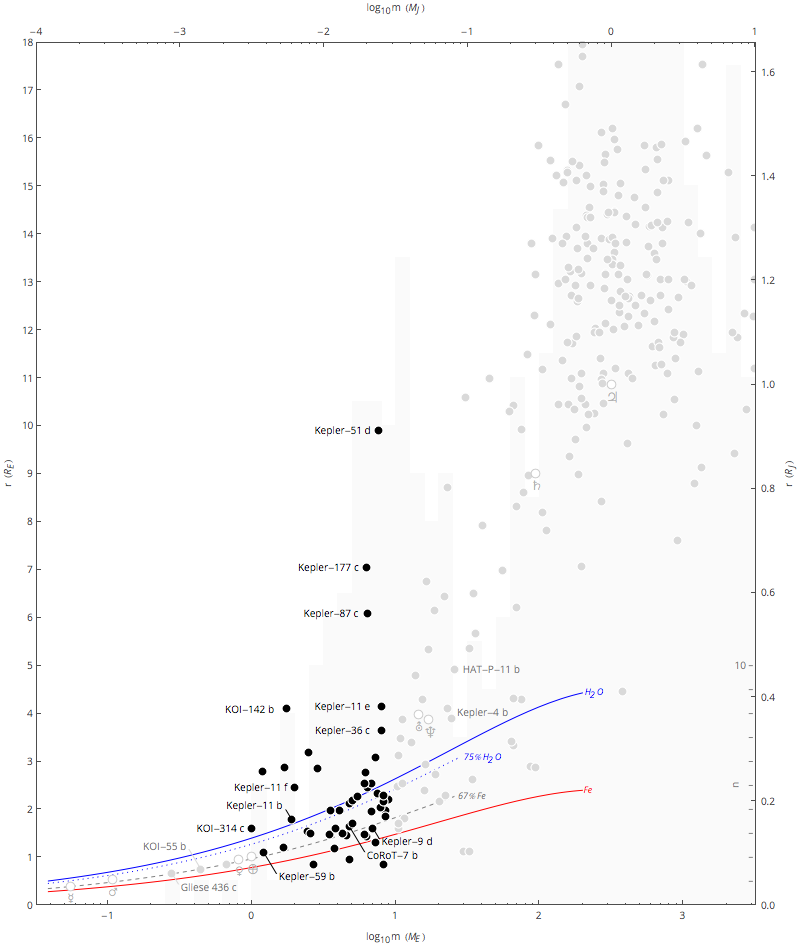
English: Scatter plot of super-Earth characteristics in context showing the mass, m, and radius, r, for
transiting Super-Earths, (black dots),
compared with those of Solar System planets (gray circles), and
other transiting exoplanets (gray dots)
along with the distribution, n (light gray bar chart), of minimum masses (see "important note" below) of transiting and non-transiting exoplanets,
detected through 2014-04-19. Scales indicate (log10 of) planetary mass, m, expressed as Earth masses (bottom) and Jupiter masses (top); planetary radius, r, expressed in Earth radii (left) and Jupiter radii (right); and counts n (gray ticks on right). References lines are provided for approximate mass-radius relationships[1] for selected planetary compositions: H2O - hypothetical pure water (ice) planet; any planet above this line has a significant H/He envelope;
75% H2O (+ 3% Fe; 22% MgSiO3) - water world;
67% Fe (+ 32.5% MgSiO3) - rocky terrestrial;
Fe - hypothetical pure iron planet, exoplanets below this line are not likely.
Exoplanet data is from the Open Exoplanet Catalogue,[2] version 4945b99. The figure shows all planets up to 10 MJ (omitting 59 more massive planets), and transiting planets up to 18 RE (omitting an additional 17 with m ≤ 10 MJ but r > 18 RE). PSR B1257+12 b (with m < 10-4 MJ), lies off to the left of the graph, and is also omitted. Important note: This figure is intended to serve as a catalog of generally accepted candidate exoplanets using the distribution of some of their basic properties related to detection. No attempt has been made to characterize the degree of confidence (which varies widely) in the existence of a given planet or its properties. Nor is any attempt made to convey systematic errors associated with a particular method. In particular, the indicated mass, m, for an exoplanet characterized using radial velocity is the minimum mass (so that the actual distribution of masses for non-transiting planets may be shifted and "smeared" significantly to the right).
|
| 日付 | |
| 原典 | 投稿者自身による著作物 |
| 作者 | Aldaron, a.k.a. Aldaron |
| その他のバージョン |
Related graphs
|


ライセンス

|
この作品の著作権者である私は、この作品についての権利を放棄しパブリックドメインとします。これは全世界で適用されます。 一部の国では、これが法的に可能ではない場合があります。その場合は、次のように宣言します。 私は、あらゆる人に対して、法により必要とされている条件を除き、如何なる条件も課すことなく、あらゆる目的のためにこの著作物を使用する権利を与えます。 |
ファイルの履歴
過去の版のファイルを表示するには、その版の日時をクリックしてください。
| 日時 | サムネイル | 寸法 | 利用者 | コメント | |
|---|---|---|---|---|---|
| 現在の版 | 2014年4月25日 (金) 13:46 | | 800 × 947 (69キロバイト) | wikimediacommons>Aldaron | Tidy labels. |
ファイルの使用状況
以下のページがこのファイルを使用しています:
