ファイル:Tautochrone curve.gif
ナビゲーションに移動
検索に移動
高解像度版はありません。
Tautochrone_curve.gif (300 × 200 ピクセル、ファイルサイズ: 102キロバイト、MIME タイプ: image/gif、ループします、80 フレーム、3.2秒)
概要
| 解説 |
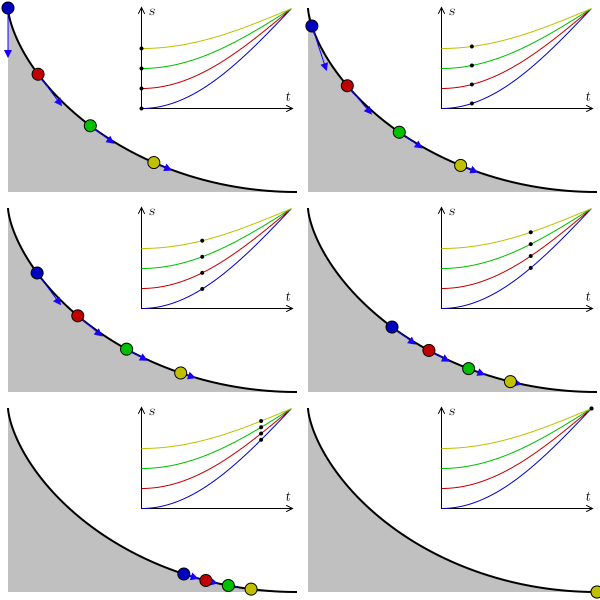
A tautochrone curve is the curve for which the time taken by an object sliding without friction in uniform gravity to its lowest point is independent of its starting point. Here, four points at different positions reach the bottom at the same time. In the graphic, s represents arc length, t represents time, and the blue arrows represent acceleration along the trajectory. As the points reach the horizontal, the velocity becomes constant, the arc length being linear to time. |
| 日付 | 2007年5月9日; new version 2009年8月 |
| 原典 | 投稿者自身による著作物 |
| 作者 |
Claudio Rocchini |
| GIF 開発 | |
| ソースコード | Python code#!/usr/bin/python
# -*- coding: utf8 -*-
'''
animation of balls on a tautochrone curve
'''
import os
import numpy as np
import matplotlib.pyplot as plt
import matplotlib.patches as patches
from matplotlib import animation
from math import *
# settings
fname = 'Tautochrone curve'
width, height = 300, 200
nframes = 80
fps=25
balls = [
{'a':1.0, 'color':'#0000c0'},
{'a':0.8, 'color':'#c00000'},
{'a':0.6, 'color':'#00c000'},
{'a':0.4, 'color':'#c0c000'}]
def curve(phi):
x = phi + sin(phi)
y = 1.0 - cos(phi)
return np.array([x, y])
def animate(nframe, empty=False):
t = nframe / float(nframes - 1.)
# prepare a clean and image-filling canvas for each frame
fig = plt.gcf()
fig.clf()
ax_canvas = plt.gca()
ax_canvas.set_position((0, 0, 1, 1))
ax_canvas.set_xlim(0, width)
ax_canvas.set_ylim(0, height)
ax_canvas.axis('off')
# draw the ramp
x0, y0 = 293, 8
h = 182
npoints = 200
points = []
for i in range(npoints):
phi = i / (npoints - 1.0) * pi - pi
x, y = h/2. * curve(phi) + np.array([x0, y0])
points.append([x, y])
rampline = patches.Polygon(points, closed=False, facecolor='none',
edgecolor='black', linewidth=1.5, capstyle='butt')
points += [[x0-h*pi/2, y0], [x0-h*pi/2, y0+h]]
ramp = patches.Polygon(points, closed=True, facecolor='#c0c0c0', edgecolor='none')
# plot axes
plotw = 0.5
ax_plot = fig.add_axes((0.47, 0.46, plotw, plotw*2/pi*width/height))
ax_plot.set_xlim(0, 1)
ax_plot.set_ylim(0, 1)
for b in balls:
time_array = np.linspace(0, 1, 201)
phi_pendulum_array = (1 - b['a'] * np.cos(time_array*pi/2))
ax_plot.plot(time_array, phi_pendulum_array, '-', color=b['color'], lw=.8)
ax_plot.set_xticks([])
ax_plot.set_yticks([])
ax_plot.set_xlabel('t')
ax_plot.set_ylabel('s')
ax_canvas.add_patch(ramp)
ax_canvas.add_patch(rampline)
for b in balls:
# draw the balls
phi_pendulum = b['a'] * -cos(t * pi/2)
phi_wheel = 2 * asin(phi_pendulum)
phi_wheel = -abs(phi_wheel)
x, y = h/2. * curve(phi_wheel) + np.array([x0, y0])
ax_canvas.add_patch(patches.Circle((x, y), radius=6., zorder=3,
facecolor=b['color'], edgecolor='black'))
ax_plot.plot([t], [1 + phi_pendulum], '.', ms=6., mec='none', mfc='black')
v = h/2. * np.array([1 + cos(phi_wheel), sin(phi_wheel)])
vnorm = v / hypot(v[0], v[1])
# in the harmonic motion, acceleration is proportional to -position
acc_along_line = 38. * -phi_pendulum * vnorm
ax_canvas.arrow(x, y, acc_along_line[0], acc_along_line[1],
head_width=6, head_length=6, fc='#1b00ff', ec='#1b00ff')
fig = plt.figure(figsize=(width/100., height/100.))
print 'saving', fname + '.gif'
#anim = animation.FuncAnimation(fig, animate, frames=nframes)
#anim.save(fname + '.gif', writer='imagemagick', fps=fps)
frames = []
for nframe in range(nframes):
frame = fname + '_{:02}.png'.format(nframe)
animation.FuncAnimation(fig, lambda n: animate(nframe), frames=1).save(
frame, writer='imagemagick')
frames.append(frame)
# assemble animation using imagemagick, this avoids dithering and huge filesize
os.system('convert -delay {} +dither +remap -layers Optimize {} "{}"'.format(
100//fps, ' '.join(['"' + f + '"' for f in frames]), fname + '.gif'))
for frame in frames:
if os.path.exists(frame):
os.remove(frame)
|


ライセンス
この作品の著作権者である私は、この作品を以下のライセンスで提供します。

|
この文書は、フリーソフトウェア財団発行のGNUフリー文書利用許諾書 (GNU Free Documentation License) 1.2またはそれ以降のバージョンの規約に基づき、複製や再配布、改変が許可されます。不可変更部分、表紙、背表紙はありません。このライセンスの複製は、GNUフリー文書利用許諾書という章に含まれています。 |
  
|
このファイルはクリエイティブ・コモンズ 表示-継承 3.0 非移植ライセンスのもとに利用を許諾されています。 | |
| ||
| このライセンスのテンプレートは、GFDLのライセンス・アップデートによりこのファイルに追加されたものです。 |
このファイルはクリエイティブ・コモンズ 表示 2.5 一般ライセンスのもとに利用を許諾されています。
- あなたは以下の条件に従う場合に限り、自由に
- 共有 – 本作品を複製、頒布、展示、実演できます。
- 再構成 – 二次的著作物を作成できます。
- あなたの従うべき条件は以下の通りです。
- 表示 – あなたは適切なクレジットを表示し、ライセンスへのリンクを提供し、変更があったらその旨を示さなければなりません。これらは合理的であればどのような方法で行っても構いませんが、許諾者があなたやあなたの利用行為を支持していると示唆するような方法は除きます。
あなたは上記のライセンスから、どれか一つ以上を選択できます。
ファイルの履歴
過去の版のファイルを表示するには、その版の日時をクリックしてください。
| 日時 | サムネイル | 寸法 | 利用者 | コメント | |
|---|---|---|---|---|---|
| 現在の版 | 2009年8月1日 (土) 14:15 | | 300 × 200 (102キロバイト) | wikimediacommons>Geek3 | new physically correct version |
ファイルの使用状況
以下のページがこのファイルを使用しています:
